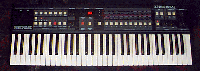
SEQUENTIAL CIRCUITS MULTI-TRACK
SYNTHESIZER/SEQUENCER - 100 PRESETS
PREFACE
FROM THE OPERATION MANUAL
"The velocity-sensitive, multi-timbral MULTI-TRAK combines the superior expressiveness of velocity touch sensitivity with the compositional flexibility of multi-timbral sound, as pioneered by Sequential with the Six-Trak and MAX synthesizers. Other features of the MULTI_TRAK include a built-in multi-track sequencer, a chorus effect for richer sounds, a split keyboard, individual audio outputs for each voice, a cassette interface for program and sequence storage, and, of course, MIDI (Musical Instrument Digital Interface).
The block diagram (page vii) shows the main sub-sections: keyboard, sequencer, sound memory, voices, and MIDI. Using this as a basis for discussion, we trace backwards from the audio output, to see how the sub-sections, work together. There are two types of audio outputs, the Mix outputs and the Track outputs. The Mix outputs, A and B, provide a psuedo-stereo effect from the chorus. Stereo headphones can be plugged into either Mix output. The Track outputs are useful in studio situations, where each voice can be run through its own channel of the main mixer board. If a Track output is used, its voice is removed from the MULTI-TRAK's Mix outputs.
These audio outputs come from the six independent synthesizer voices. In contrast to homophonic synthesizers, which program each voice with the same sound, each of the MULTI-TRAK's voices can have a different sound (multi-timbre). Each voice has a multi-waveform oscillator (or noise) as the principal sound source. The oscillator drives a resonant low-pass filter which contours the timbre, and an amplifier which contours the dynamics. There are three attack-decay-sustain-release (ADSR) envelope generators: one for oscillator frequency, one for filter cutoff frequency, and one for amplifier gain. (The polarity of the first two can be inverted.) A triangle- or square-wave low frequency oscillator (LFO) can modulate oscillator frequency, pulse width, or filter frequency. The amount of LFO modulation can be controlled with the Mod wheel. A second modulation route runs from the oscillator triangle output to the filter frequency, for frequency modulation (FM). Frequency glide ("portamento") and voice volume are programmable. A Pitch wheel is provided for bending notes. Non-programmable master volume and tuning controls are provided. The TUNE switch has been eliminated by fully-automatic oscillator tuning, although a manual tune command is still available.
A voice has two types of inputs. First are the sound parameters from the sound memory. These operate on the synthesizer voices to define the track's timbre-in other words, the instrumental sound. The synthesizer program memory stores 100 sound programs, each consisting of 40 voice parameters. 100 instrumental sounds and effects are factory-programmed, but the player can modify (edit) these as desired. Light-emitting diodes (LEDs) clearly indicate the selected program, and if the program is being edited, they also display the parameter value and indicate which parameter is being edited. You use a single knob to change all parameter values. Programs can be copied. And the non-volatile memory is retained when power is off, thanks to a long-life backup batter. To permanently back-up programs and sequences, provision is made for storing them on audio cassette
The second type of input to a voice are notes. Notes tell the voice to play and what pitch to play. A voice can be played by notes coming from three sources: the keyboard, the sequencer, and MIDI. The MULTI-TRAK has a five-octave keyboard which you can use to overdub tracks, to play one or more voices live along with recorded sequences, or to play six voices live with either one sound (polyphonic or unison), or multiple timbres (in Stack or Split modes). The velocity with which a key is played can affect the loudness or brightness of the note, or the amount of LFO modulation applied. Other keyboard modes include voice stacking (for fatter sounds), a programmable split point, and a flexible arpeggiator.
When playing the MULTI-TRAK keyboard "live," each key played has the same sound (homophonic mode), except in Split mode, where the keyboard can be divided into two parts, each with its own timbre. When playing live, more complex multi-timbres are not possible because the MULTI-TRAK cannot know which keystrokes you intend for which timbres.
But the sequencer can record whatever you play on the keyboard as a separate track using its own voice. So each track can be overdubbed with a different sound. The sequencer allows overdubbing and editing without re-recording, splicing, or accumulating noise and distortion by "mixing-down" and "bouncing" audio tape tracks
The 1600-note memory can be allocated to four sequences. Sequencer functions include overdubbing, programmable playback speed, programmable track volume, track erase, warning of memory-full, built-in metronome and autocorrect, an append function (which adds sequences together), and sync-to-tape.Thirdly, the voices can play notes coming in from MIDI, which may be from another synthesizer or an external sequencer.
The MULTI-TRAK can send live notes, recorded notes, or sounds out to MIDI. For example, Sequential's Model 242 MIDI Interface Cartridge for the Commodore 64, and associated 900- series software, offers increased sequencer storage (up to 4000 notes), program and sequence storage on cassette or disc, and song transposition, as well as forthcoming music display and editing functions.
Finally, if you use a MIDI rhythm unit (such as the Sequential Model 400 Drumtraks), it sends a MIDI clock to the MULTI-TRAK sequencer, which synchronizes the MULTI-TRAK song to the drum song (or pattern).
Note: For more information on MIDI applications and use with Sequential's Drumtraks, please see the MULTI-TRAK MIDIGUIDE.
In order to get the most from the wealth of features found in your new MULTI-TRAK, we hope you will study this manual and the MIDIGUIDE thoroughly, and keep the reference card on hand while performing. You will find the MULTI-TRAK to be a most versatile music tool, both in itself and with its powers of MIDI expandability."
SYNTHESIZER PARAMETERS
| OSCILLATOR FREQENCY | ||
|---|---|---|
| COARSE FREQUENCY | VALUE RANGE: 00-48 | ADJUSTS OSC PITCH IN SEMITONES |
| FINE FREQUENCY | VALUE RANGE: 00-31 | ADJUSTS OSC FREQ WITHIN ONE SEMITONE |
| FREQUENCY LFO MOD | VALUE RANGE: 00/01 | ENABLES LFO MODULATION TO OSC FREQ |
| OSCILLATOR WAVESHAPE | ||
| SAWTOOTH | VALUE RANGE: 00/01 | FULL-LEVEL WAVE CONTAINING ALL HARMONICS |
| TRIANGLE | VALUE RANGE: 00/01 | TRIANGLE WAVE CONTAINING LITTLE HARMONICS |
| PULSE | VALUE RANGE: 00/01 | HARMONICS DEPEND ON PULSE WIDTH AND LFO MOD |
| MODIFIERS | ||
| PULSE WIDTH | VALUE RANGE: 00-63 | ADJUST HARMONIC CONTENT OF PULSE WAVE |
| PW MOD | VALUE RANGE: 00/01 | APPLIES LFO MOD TO OSC PULSE WIDTH |
| GLIDE | VALUE RANGE: 00-15 | PORTAMENTO EFFECT |
| NOISE MIX | VALUE RANGE: 00-31 | ADJUSTS RATIO OF OSC AND NOISE TO FILTER |
| LFO | ||
| FREQUENCY | VALUE RANGE: 00-15 | ADJUST LFO FREQ FROM 1/4 TO 20Hz |
| AMOUNT | VALUE RANGE: 00-31 | MOD DEPTH - MOD WHEEL IS ADDED TO THIS AMOUNT |
| TRIANGLE WAVE | VALUE RANGE: 00/01 | SELECTS TRIANGLE WAVE FOR VIBRATO |
| SQUARE WAVE | VALUE RANGE: 00/01 | SELECTS SQUARE WAVE FOR TRILLS |
| OSCILLATOR ENVELOPE | ||
| ENVELOPE AMOUNT | VALUE RANGE: 00-15 | SETS DEPTH OF OSC ENV MOD |
| INVERT | VALUE RANGE: 00/01 | TURNS OSC ENV UPSIDE DOWN |
| ATTACK | VALUE RANGE: 00-31 | ADJUSTS TIME ENV GOES FROM ZERO TO MAX |
| DECAY | VALUE RANGE: 00-31 | ADJUSTS TIME ENV GOES FROM MAX TO SUSTAIN |
| SUSTAIN | VALUE RANGE: 00-15 | ADJUST SUSTAIN LEVEL FROM ZERO TO MAX |
| RELEASE | VALUE RANGE: 00-31 | ADJUSTS TIME ENV GOES FROM SUSTAIN TO ZERO |
| FILTER | ||
| CUTOFF | VALUE RANGE: 00-127 | ADJUSTS CUTOFF FREQ FOR (4-POLE) LOW-PASS FILTER |
| RESONANCE | VALUE RANGE: 00-63 | ADJUSTS AMOUNT OF FILTER RESONANCE |
| LFO MOD | VALUE RANGE: 00/01 | SWITCHES LFO MOD TO FILTER |
| OSC MOD | VALUE RANGE: 00-63 | CONTROLS FREQ-MOD |
| FILTER ENVELOPE | ||
| ENVELOPE AMOUNT | VALUE RANGE: 00-15 | ADJUSTS DEPTH OF FILTER ENV MOD |
| INVERT | VALUE RANGE: 00/01 | INVERTS FILTER CONTOUR |
| ATTACK | VALUE RANGE: 00-32 | |
| DECAY | VALUE RANGE: 00-31 | |
| SUSTAIN | VALUE RANGE: 00-15 | |
| RELEASE | VALUE RANGE: 00-31 | AMP ENV REL SHOULD BE SET TO SAME OR GREATER |
| KYBD TRACK | VALUE RANGE: 00-02 | SETS FILTER/CUTOFF FREQ TRACKING OF KEYBOARD |
| VELOCITY SENSITIVITY | ||
| AMP PEAK | VALUE RANGE: 00-15 | CONTROLS SENSITIVITY OF AMP VEL MOD |
| FILTER PEAK | VALUE RANGE: 00-15 | CONTROLS SENSITIVITY OF FILTER VEL MOD |
| LFO AMOUNT | VALUE RANGE: 00-15 | CONTROLS SENSITIVITY OF LFO VEL MOD |
| UNISON | ||
| UNISON | VALUE RANGE: 00/01 | MONOPHONIC MODE - 6 VOICES ASSIGNED TO NOTE |
| AMPLIFIER ENVELOPE | ||
| VOICE VOLUME | VALUE RANGE: 00-15 | SETS VOLUME OF INDIVIDUAL PATCH |
| ATTACK | VALUE RANGE: 00-31 | |
| DECAY | VALUE RANGE: 00-31 | |
| SUSTAIN | VALUE RANGE: 00-15 | |
| RELEASE | VALUE RANGE: 00-31 | |
| CHORUS ON/OFF | VALUE RANGE: 00/01 | DEPTH AND RATE CONTROLLED BY KNOB |
ARPEGGIATE
FROM THE OPERATION MANUAL
"The arpeggiator is a very useful keyboard memory feature with two basic modes: Up/Down and Assign. In either mode you can "latch" the arpeggiator, so it continues to play even when you remove your hands from the keyboard. After latching, the arpeggiatednotes can be transposed.
The arpeggiator uses voice 6 only. For either Up/Down or Assign modes, the arpeggiator will recognize a maximum of sixteen held keys.
Note: SEQUENCER, Stacks, and Parameter Edit must all be off before using the arpeggiator."
STACKS/SPLITS
FROM THE OPERATION MANUAL
"In the MULTI-TRAK a stack consists of up to six different timbres (programs) assigned to each note played on the keyboard. Intervals can be stacked, usually by simply adjusting the OSCILLATOR COARSE FREQUENCY parameter for the various programs. This enables the creation of very complex sounds by playing up to six programs at once. Stack mode can be played polyphonically, with two or three notes playable at a time, depending on how many tracks are used for the stack.
Additionally, the stacks can be used to store split-points for the MULTI-TRAK's keyboard. Any number of tracks (up to five) can be ssigned to the left side of the keyboard, with the remainder assigned to the right. And each side of the split can be programmed to either play polyphonically or as a monophonic stack.
Ten different stack/split presets can be stored in the MULTI-TRAK's memory."
CASSETTE INTERFACE
FROM THE OPERATION MANUAL
"The MULTI-TRAK microcomputer transforms the instrument's sonic identity into digital data stored in semiconductor memory (RAM). The cassette interface enables this sonic data to be transfered to and from common audio cassettes, enabling you to build up an unlimited stock of programs and sequences. It then becomes easy to change the MULTI-TRAK's personality at any time, since reprogramming by tape only takes a few minutes. This means if a MULTI-TRAK is going to be at your destination, you can leave your MULTI-TRAK home and bring only the cassets you need to personalize the instrument. However, the most important benefit of tape storage is program protection from accidental erasure, component failure, or instrument damage.
The 100 Factory Programs and four demonstration sequences are included on a cassete with each MULTI-TRAK. Inasmuch as the Factory Programs provide many points of departure for editing into custom sounds, we suggest making a backup copy of this cassette as soon as you learn how to use the interface.
Operation of the cassette interface is extremely simple, as programs or sequences are saved or loaded in one operation."
FACTORY PROGRAMS
| 00 - ORGAN I | 01 - ORGAN--FLUTES | 02 - ORGAN--VELOCITY LESLIE I |
| 03 - ORGAN--VELOCITY LESLIE II | 04 - ORGAN II | 05 - ORGAN--BRIGHT |
| 06 - ORGAN 4' STOP | 07 - HEAVY LESLIE | 08 - ORGAN III |
| 09 - ORGAN 8' STOP | 10 - BRASS I | 11 - BRASS II | 12 - POP BRASS | 13 - CORNET | 14 - BACH TRUMPET |
| 15 - MOCK HORN | 16 - DIGI HORN | 17 - BRASS III |
| 18 - BRASS IV | 19 - LOW BRASS | 20 - STRING I |
| 21 - STRING II | 22 - STRING HIGH I | 23 - STRING III |
| 24 - STRING IV | 25 - STRING HIGH | 26 - STRING V |
| 27 - LOW VCA SWELL | 28 - HIGH STRING II | 29 - HIGH STRING III |
| 30 - SYNTHY | 31 - CLAV I | 32 - HARPSICHORD |
| 33 - E. PIANO WITH CHORUS | 34 - SYNTHY CHORUS | 35 - SYNTH/CLAV |
| 36 - ELECTRIC PIANO | 37 - PIANO (ACOUSTIC) HIGH HALF | 38 - PIANO (ACOUSTIC) LOW HALF |
| 39 - FLUTY-CLAV | 40 - TAUR I | 41 - STRING BASS |
| 42 - BASS-RES I | 43 - CLAVTRON | 44 - JACO BASS |
| 45 - BASS II | 46 - BACKWARDS BASS | 47 - BASS WITH RELEASE TICK |
| 48 - HEAVY BASS | 49 - TAUR II | 50 - SYN-TOM I |
| 51 - BASS DRUM | 52 - SYN TOM II | 53 - SYNTH. COWBELL |
| 54 - AFRICAN LOG | 55 - SPACE DRUM | 56 - NOISE BURST I |
| 57 - SCRATCH | 58 - NOISE BURST II | 59 - AGOG. BELL |
| 60 - SYNTH CHORDS | 61 - SCI-FI | 62 - RES I |
| 63 - ECHO | 64 - MIRIDIUM | 65 - PLEIADES |
| 66 - RES II | 67 - HIGH SYNTH | 68 - ARTEMEIDES |
| 69 - FLUTE | 70 - CHLOE | 71 - KARI |
| 72 - 5TH'S RELEASE | 73 - GLIDE/RES | 74 - FILT RES. LOW SWEEP |
| 75 - RES III | 76 - PIANO--KIND | 77 - TRIANGLE |
| 78 - SAWTOOTH | 79 - SQUARE | 80 - LEAD I |
| 81 - LEAD II | 82 - LEAD III | 83 - LEAD IV |
| 84 - CLARI-UNI | 85 - UNISON--LONG GLIDE | 86 - DROPPED PITCH LEAD |
| 87 - WAK LEAD | 88 - LUCKY MAN | 89 - BACKWARDS TRIANGLES |
| 90 - SARAN | 91 - GROAN | 92 - WIND |
| 93 - LEECHES | 94 - SQUARE WAVE THRILL | 95 - LAZAR |
| 96 - ALMOST BOMB | 97 - DISCOVERY | 98 - POLYCHORDS |
| 99 - ALIEN |